🎉 Our paper Agentic Context Engineering (ACE) has been accepted to ICLR 2026!
We are excited to share that our work on building self-improving language agents through context evolution will appear at the International Conference on Learning Representations (ICLR) 2026.
ACE explores a simple but powerful idea: instead of updating model weights, how do we continuously evolve an agent’s context, memory, and tools at test time to make it smarter over time? The ACE paper improves both quality and efficiency for the emerging learning context problem on both offline and online scenarios.
We release the code on Github with easy reproduction. Moreover, we are building the ACE repo as a research platform for researchers to further explore context-based learning and self-improving agents. We are currently filling the support matrix for the most popular datasets and current frameworks, and welcome contributions from the community!
What is ACE?
Large language model agents are increasingly deployed in complex, multi-step environments: coding assistants, research copilots, data analysis agents, and more. But today’s systems are often stateless: each run starts fresh, discarding what was learned from previous attempts.
Agentic Context Engineering (ACE) introduces a new paradigm for test-time adaptation:
Instead of changing weights, ACE evolves the context supplied to an agent (its memories, plans, summaries, tools, and distilled experience) so the agent improves as it operates.
Concretely, ACE provides:
- Empirical analysis and new understanding of why prior context-evolution methods can fail silently or suddenly in multi-turn, long-horizon agentic tasks
- A unified framework for capturing and structuring experience from prior executions without suffering from brevity bias and context collapse
- Evaluation across diverse agentic and reasoning tasks, showing consistent performance and efficiency gains without retraining the underlying model
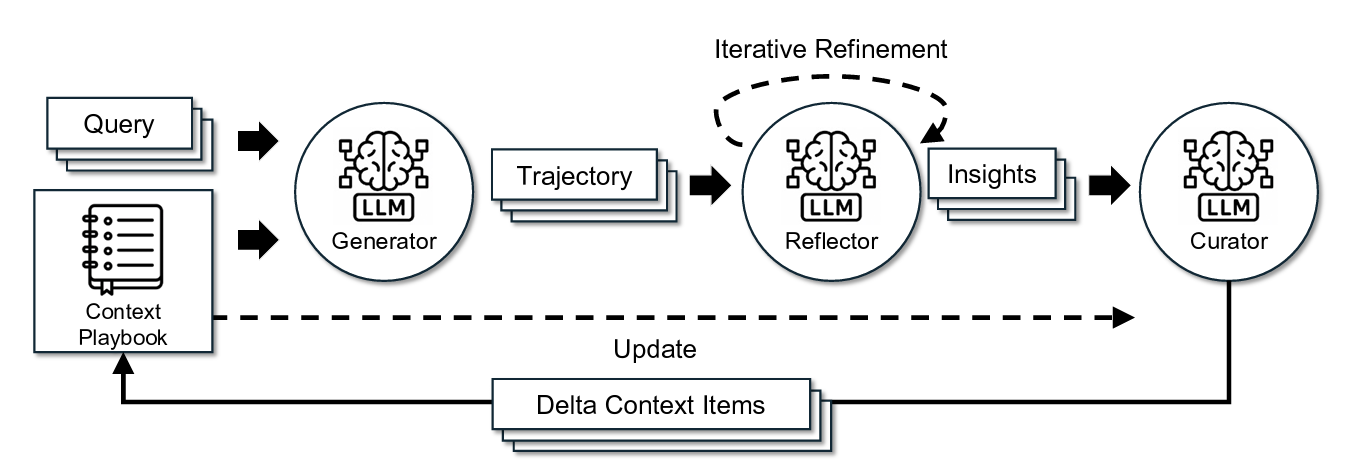
Across coding, tool-use, and domain-specific reasoning benchmarks, ACE demonstrates that carefully engineered and continuously evolving contexts can unlock strong improvements in task success rate, efficiency, and robustness, thus pushing toward self-improving AI systems that learn from experience in deployment.
If you are interested in how test-time memory, learning from experience, reflection, and planning interact with modern LLM systems, we think ACE will resonate with you!
ACE as a Context Evolution Research Platform
Since releasing ACE, we’ve been thrilled to see growing interest from the research and open-source communities:
- ⭐️ Active development at github.com/ace-agent/ace
- 📣 Talks and presentations at Hippocratic AI, HKU NAISS Lab, and more to come
- 🤝 New research collaborations building on ACE as a platform for studying context-based methods and self-evolving agents at Stanford, MIT, …
Over the next few weeks and months, we plan to release several major additions to the ACE platform across datasets, system features, and new research directions:
| Datasets and Benchmarks | DDXPlus (medical reasoning), BIRD-SQL (text-to-SQL), Terminal-Bench (terminal agents), ... |
| Features | ACE + Agent Skills, ACE + Recursive Language Models, ... |
| New Research | Meta-Memory Evolution, Tool-Augmented Context, ... |
ICLR 2026 is just the beginning. We see ACE as part of a broader research agenda around a new paradigm for context-driven learning and test-time adaptation in AI systems. If you’re working on related problems or interested in building on the ACE platform, we’d love to hear from you!
Contact Us
Shoot us an email at qizhengz@stanford.edu.